
Archive for the ‘telecom’ Category

Bilgi İmparatorluklarının Yükselişi ve Düşüşü

Monday, November 22nd, 2010

Tim Wu

Tim Wu

2003 yılında Harward Üniversitesinden bir hukuk profesörü, Tim Wu, “Network Neutrality, Broadband Discrimination” başlıklı bir yazısı ile 2000′li yılların başından itibaren büyük internet servis sağlayıcılarının ve telekom operatörlerinin ısrarla üzerinde durduğu internet erişim servislerinin, verilerin içeriğine göre önceliklendirilmesini ve dosya vs. paylaşımı yapanların internet erişimlerinin kademeli olarak kesilmesini vs. öngören “master planlarına” karşılık “net neutrality” kavramıyla ortaya çıkıp, internetin neden nötral olması gerektiğini savunuyordu.  “Net Neutrality” kavramı internetin her türlü içerik, site ve platformu aynı şekilde ele almasını, her türlü bilgiyi aynı şekilde taşımasını / iletmesini ve her türlü uygulamayı desteklemesini savunan bir çeşit ağ tasarım prensibi / network design principle” üzerine kurulu. (Avrupa Birliği’nin geçtimiz yıl üzerinde durduğu “Telecom Package” ve “Three Strike” uygulamaları düşünülünce konunun önemi daha iyi anlaşılacaktır. Bkz : AB Telekom Paketi, Bireysel Özgürlükler ve Yasaklar, 11 Mayıs 2009)
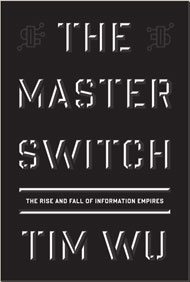
The Master Switch - Kapak

Tim Wu, internet, hukuk, telif hakları konularında çalışan, internetin açık yapısının hararetli bir savunucusu olan bir hukuk profesörü ve aynı zamanda aktivist. Kasım ayının başında “The Master Switch / Rise and Fall of Information Empires – Ana Şalter / Bilgi İmparatorluklarının Yükselişi ve Çöküşü” isimli ikinci kitabını yayınladı. (kitap henüz türkçe’ye çevrilmedi) Kitabı ilginç kılan ise 1800’lü yıllardan günümüze telgraf, telefon, projectör/kamera, radyo, televizyon ve nihayet internet’in bulunması ve kullanıma girmesi ile oluşan bilgi dönemlerini ve bu dönemlerin karakteristik özelliklerini inceleyerek, bu buluşların nasıl bir endüstri oluşturduğunu, oluşan bu endüstrilerin nasıl monopol yapılara evrildiğini ve bu evrilmenin nelere yol açtığını çok zengin anekdotlarla bezeyerek, sade ve akıcı bir dil ile okurlara sunuyor. Ve sonunda “internet” in kaderinin de kendinden önceki devrimsel nitelikteki kitle iletişim araçlarının (telgraf, telefon, radyo, TV vb.) kaderleriyle aynı olup olmayacağını soruyor.

“Markets are born free, yet no sooner are they born than some would-be emperor is forging chains. The federal government is usually recruited to help out the mogul and his plans to gain control over the technology and product. Another disruptive technology, or a public-spirited government, breaks up the mogul-driven business model, and the Cycle starts anew.”

Kitap çığır açan bu buluşların önce kendi sektörlerini yarattığını ve bu sürecinde açık bir süreç olduğunu ve yeniliğe (innovation) açık olduğunu fakat bir sure sonra bu açıklığın gerek monopol yapıların oluşması, gerekse de devletin müdahalesiyle nasıl kapalı ve yenilikçiliği (innovation) kısıtlayan sektörlere dönüştüğünü, yani kapalı yapılar haline geldiğini anlatırken, bir süre sonra da yeni bir teknolojinin, “disruptive innovation”,  tekrar o sektörü açık bir hale getirebildiğini gösteriyor. Bunu gösterirken de “Cycle / Döngü” kavramı ile de her açık sistemin hep açık kalmadığı ve bir sure sonra gerek regülasyon, gerekse de monopol yapılar ve devasa şirketler yüzünden kapanabildiğini anlatıp soruyor; tüm zamanların en açık ve merkezi olmayan sistemi olan “internet” in akıbeti ne olacak?

Yazar kitabın amacını şöyle özetliyor:

It has been the aim of this book to show that our information industries –the defining business ventures of our time- have from their inception been subject to the same cycle of rise and fall, imperial consolidation and dispersion, and that the time has come when we must pay attention.

Kitap hem bilgi çağının nasıl evrildiğini hem de bu süreçte ekonomik sistemin ve şirketlerin bu süreci nasıl algıladıklarını göstermesi bakımından çok değerli gözlemler ve gerçekler sunuyor. Aynı zamanda telgraf, telefon, radyo, film endüstrisi, TV ve internetin keşiften kitlelere ulaşma sürecinde çok güzel anekdotlarla okuyucuyu konuya sürekli bağlı tutabiliyor. Bu yönüyle teknoloji, medya ve kitle iletişim araçlarıyla ilgilenenlerin mutlaka okuması gereken bir kitap.

“Every age thinks it’s the modern age, but this one really is. (Tom Stoppard  / The Invention of  Love)”

Neşeli bir hafta dileğiyle…


*The Master Switch / Tim Wu
Rise and Fall of Information Empires
Published by Alfred A. Knopf
November 2, 2010

-

Mobile Data Business and Smartphones

Monday, June 14th, 2010

The face of communication changes? Should we change our revenue strategy? Do we strongly  rely on voice to uphold our business model? I think these are popular questions  operators and their business partners ask each other.

Growth in use of new communication channels like social networking tools, microblogs and VoIP (Skype) is changing the face of the communication. Users are using those services more and more and therefore telecom becomes more data/connectivity centric and less voice centric. During this evolution, Smartphones are playing crucial role. Iphone and some other new mobile devices like iPad move this role one step forward. Besides this role, another important point is that smartphones account for 20 per cent of global handset sales.

This data centric model and rise of the smartphones bring not only new business model but also some problems. Let’s remember iPhone launch in U.S.A .and U.K. AT&T network experienced some kind of network overload/congestion, slow network speeds and dropped calls etc. From New York Times article, Customers Angered as iPhones Overload AT&T, : “It’s a data guzzler. Owners use them like minicomputers, which they are, and use them a lot. Not only do iPhone owners download applications, stream music and videos and browse the Web at higher rates than the average smartphone user, but the average iPhone owner can also use 10 times the network capacity used by the average smartphone user.“. One week later, AT&T Urged customers to use less wireless data: “AT&T is considering ways to encourage customers to use less wireless data as its network struggles to keep up with demand, a company executive said Wednesday.” (New York Times, December 10, 2009, http://www.nytimes.com/2009/12/10/technology/companies/10iphone.html)

Similar case from iPhone operator O2 in U.K. : “The head of U.K. carrier O2 apologized to London customers who faced service issues this year, due to what’s being blamed on an abundance of bandwidth-devouring iPhone users. O2 said it’s working with Nokia Siemens, Apple and also RIM to find solutions. (Eweek, Dec 29, 2009 – O2 apologizes for boggy iPhone service in London)

According to a research from Morgan Stanley, smartphone users use more data than average mobile users. Moreover, iPhone users use more and more data than smartphone users.

Another point: In every region, the top five percent of subscribers account for 50 percent of network traffic (According to a study from Sandvine). AT&T has observed that the top three percent of its smartphone users generate 40 percent of its all data traffic. (Source: http://mobile-voip.tmcnet.com/topics/mobile-voip/articles/79523-mobile-broadband-whats-different.htm)

Most of mentioned users (top five percent and AT&T’s top three percent) have a flat-rate data plans. In developing countries, flat-rate data plans are essential to drive customer demand but the question is if this kind of pricing is sustainable in long-run as smartphones, iPhone and Android get bigger part of handset devices market and data usage grows? Can operators’ network infrastructure carry huge data traffic? From AT&T and O2 case -mentioned above-, they could not. They should expand and modernize their network. From this point on, another question arises: data traffic revenues can afford those investment?

According to many operators and consultancy companies, in 2012, data revenue can not afford yearly cost/investment (Since we don’t have numbers and financial details from the perspective of an operator, we can not predict it but my view/feeling is that the following forecast is overstated)

Based on this forecast and experienced network congestion, AT&T has recently changed its data plans and now offering tiered and usage-based service approaches. (CNET News, June 2, 2010, New AT&T data plans for iPhones, iPads, more)

If they believe and find the above forecast plausible,what can they do? (to me, above forecast is not plausible but overstated). Tiered and usage-based service approach is one of the solutions? If so, what else?

Bridgewater, a mobile personalization company, offers some methods in its study “Towards Profitable Mobile Data Business Model

  • Policy Control
  • Multi-Access Data Offload
  • Evolution to 4th Generation Mobile Access
  • Network Optimiztion
  • New Service Models

If you are interested in mobile data from operators’ perspective, some part of it can be useful (not entire report)

Telecommunication Sector in Coming Decade?

Friday, May 14th, 2010

Next monday, 17 May is the “World Telecommunication Day”. World Telecommunication Day has been celebrated annually on 17 May since 1969, marking the founding of International Telecommunication Union and the signing of the first International Telegraph Convention in 1865.

Although ITU Council adopted the theme “Better city, better life with ICTs” to mark World Telecommunication and Information Society Day in 2010, Talking about the “Better City, Better life with ICTs” is not so interesting to me (I may write  about it later). Since 17 May is world telecommunication day, let me take this opportunity to write about telecommunications sector (from perspective of telecommunication operators / vendors) and then information society (user rights in the digital world? ACTA?). At first, telecommunication sector.

Is Telco sector turning into a lower margin basic utility sector?

Magic word : change. Last decade was a time frame that technology, society and business evolved and changed faster than ever before and we -all- know that today’s technology and business environment is evolving and changing faster and faster than last decade. No one can claim that technology and business environment in coming decade will not evolve and change faster than today’s environment in the light of the experiences we had during the last decade. In this fast-changing world, nothing survives over the long term if it resists the change, (if) it can not change itself, (if) it can not adopt itself to the changing world or (if) it can not change itself at the same pace of “change”.

All we know is that “change” comes not only with “new things” but also with a more complex and networked things, more complex society and with more information.( sometimes, change comes with a recession or bad effects, yeah, dark side of the moon). As a result of this fast changing environment, none of us, none of the societies and none of the enterprises including telco players can survive in this environment by standing out of this change and evolution.

The question is not about the change, but about telco operators / vendors. Are they ready? Are they adopting themselves to this ever changing world?

Some facts:

  • 10 years ago, less than one in six people in the world had access to a telephone of any kind. By 2009, mobile phone was accessible for seven out of ten people worldwide.(Source: ITU ICT Statistics Database, www.itu.int)
  • Internet access shifted from dial-up to broadband (see the image file : fixed broadband subscribers in 2008) (Source : ITU ICT Statistics Database, www.itu.int )
  • Phenomenal growth of mobile broadband.(3G, HSPA, HSPDA etc.)
  • Telecom becomes more data/connectivity-centric instead of voice.

Some other facts :

  • End of a decade of golden age? Mobile market is loosing steam. Mobile ARPU (Avearge Revenue Per User) is declining. (DigiWorld Summit 2009, http://www.bloobble.com/broadband-presentations/presentations?itemid=2789)
  • Telcos are grappling with falling margins across the mature markets. British Telecom, France Telecom, KPN (Netherlands) and Telefonica (Spain) are struggling to cope with revenue declines in the range of 3-9%. (for some other telcos, 5-15% revenue decline)
  • North American telecommunication operators are facing increasing difficulties in assuring revenues from bundled services.(Source: Revenue Assurance Strategies for Recession and Recovery, 22 April 2010, Ovum Research, www.ovum.com)
  • Other services including IPTV can not afford declining voice revenues.

New technologies like Digital Subscriber Line – DSL, fiber access etc are changing the face of communication. Users are communicating in different ways like VoIP, Instant Messaging, Social Networks, blogs, twitter etc and they will use them more and more.

Number of subscribers are increasing however voice revenues are declining? Telecom becomes more data/connectivity-centric but data data revenue can not afford declining voice revenues? So far, they can provide some growth from mobile broadband but is it sustainable in long-run? Some markets are mature and saturated? Some other markets have not been saturated but they will.  So, what is the future of telco?

Since that question is so comprehensive question, I can not answer this question on my own, either but there is an interesting report focusing on the future of telco. We are going to look at that report on sunday or monday.

-

Update – May 17, 2010

Sorry but I did not have time for another blog entry on this subject. You can find the reports which I mentioned earlier.

Telecoms 2015: New Game, New Players, but Who Wins?
http://www.telco2research.com/articles/AN_Telecoms-2015-who-wins_Full

Telco 2015 :  Five Telling Years, Four future scenarios
http://www.ibm.com/common/ssi/cgi-bin/ssialias?infotype=PM&subtype=XB&appname=GBSE_GB_TI_USEN&htmlfid=GBE03304USEN&attachment=GBE03304USEN.PDF