
Mobile Data Business and Smartphones
Monday, June 14th, 2010 The face of communication changes? Should we change our revenue strategy? Do we strongly rely on voice to uphold our business model? I think these are popular questions operators and their business partners ask each other.
Growth in use of new communication channels like social networking tools, microblogs and VoIP (Skype) is changing the face of the communication. Users are using those services more and more and therefore telecom becomes more data/connectivity centric and less voice centric. During this evolution, Smartphones are playing crucial role. Iphone and some other new mobile devices like iPad move this role one step forward. Besides this role, another important point is that smartphones account for 20 per cent of global handset sales.
This data centric model and rise of the smartphones bring not only new business model but also some problems. Let”s remember iPhone launch in U.S.A .and U.K. AT&T network experienced some kind of network overload/congestion, slow network speeds and dropped calls etc. From New York Times article, Customers Angered as iPhones Overload AT&T, : “It’s a data guzzler. Owners use them like minicomputers, which they are, and use them a lot. Not only do iPhone owners download applications, stream music and videos and browse the Web at higher rates than the average smartphone user, but the average iPhone owner can also use 10 times the network capacity used by the average smartphone user.”. One week later, AT&T Urged customers to use less wireless data: “AT&T is considering ways to encourage customers to use less wireless data as its network struggles to keep up with demand, a company executive said Wednesday.” (New York Times, December 10, 2009, http://www.nytimes.com/2009/12/10/technology/companies/10iphone.html)
Similar case from iPhone operator O2 in U.K. : “The head of U.K. carrier O2 apologized to London customers who faced service issues this year, due to what’s being blamed on an abundance of bandwidth-devouring iPhone users. O2 said it’s working with Nokia Siemens, Apple and also RIM to find solutions.” (Eweek, Dec 29, 2009 – O2 apologizes for boggy iPhone service in London)
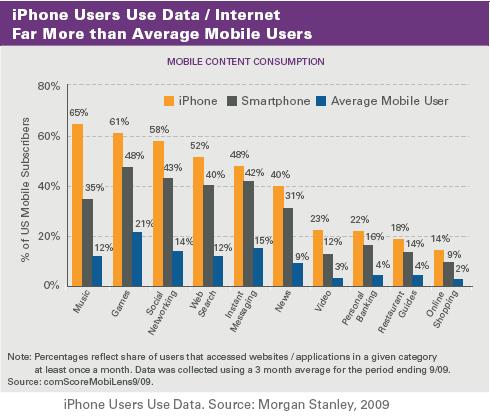 According to a research from Morgan Stanley, smartphone users use more data than average mobile users. Moreover, iPhone users use more and more data than smartphone users.
Another point: In every region, the top five percent of subscribers account for 50 percent of network traffic (According to a study from Sandvine). AT&T has observed that the top three percent of its smartphone users generate 40 percent of its all data traffic. (Source: http://mobile-voip.tmcnet.com/topics/mobile-voip/articles/79523-mobile-broadband-whats-different.htm)
Most of mentioned users (top five percent and AT&T”s top three percent) have a flat-rate data plans. In developing countries, flat-rate data plans are essential to drive customer demand but the question is if this kind of pricing is sustainable in long-run as smartphones, iPhone and Android get bigger part of handset devices market and data usage grows? Can operators” network infrastructure carry huge data traffic? From AT&T and O2 case -mentioned above-, they could not. They should expand and modernize their network. From this point on, another question arises: data traffic revenues can afford those investment?
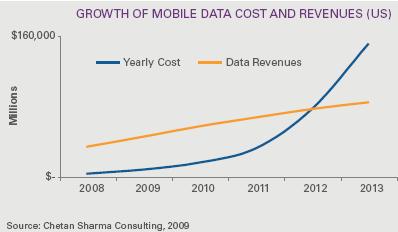 According to many operators and consultancy companies, in 2012, data revenue can not afford yearly cost/investment (Since we don”t have numbers and financial details from the perspective of an operator, we can not predict it but my view/feeling is that the following forecast is overstated)
Based on this forecast and experienced network congestion, AT&T has recently changed its data plans and now offering tiered and usage-based service approaches. (CNET News, June 2, 2010, New AT&T data plans for iPhones, iPads, more)
If they believe and find the above forecast plausible,what can they do? (to me, above forecast is not plausible but overstated). Tiered and usage-based service approach is one of the solutions? If so, what else?
Bridgewater, a mobile personalization company, offers some methods in its study “Towards Profitable Mobile Data Business Model”
- Policy Control
- Multi-Access Data Offload
- Evolution to 4th Generation Mobile Access
- Network Optimiztion
- New Service Models
If you are interested in mobile data from operators” perspective, some part of it can be useful (not entire report)


